
Author: Taryn Walters
Source: CaliberTV
“Oppose AI music, or bands like us stop existing,” frontman Lucas Woodland shared a few weeks ago on X, not long after the AI band Bleeding Verse overtook Holding Absence on Spotify — one of the two artists that it was modeled off of. Although by now their monthly listener count has gone back down, the number still remains close, and it sparks some discussion around the use of AI in the music industry.
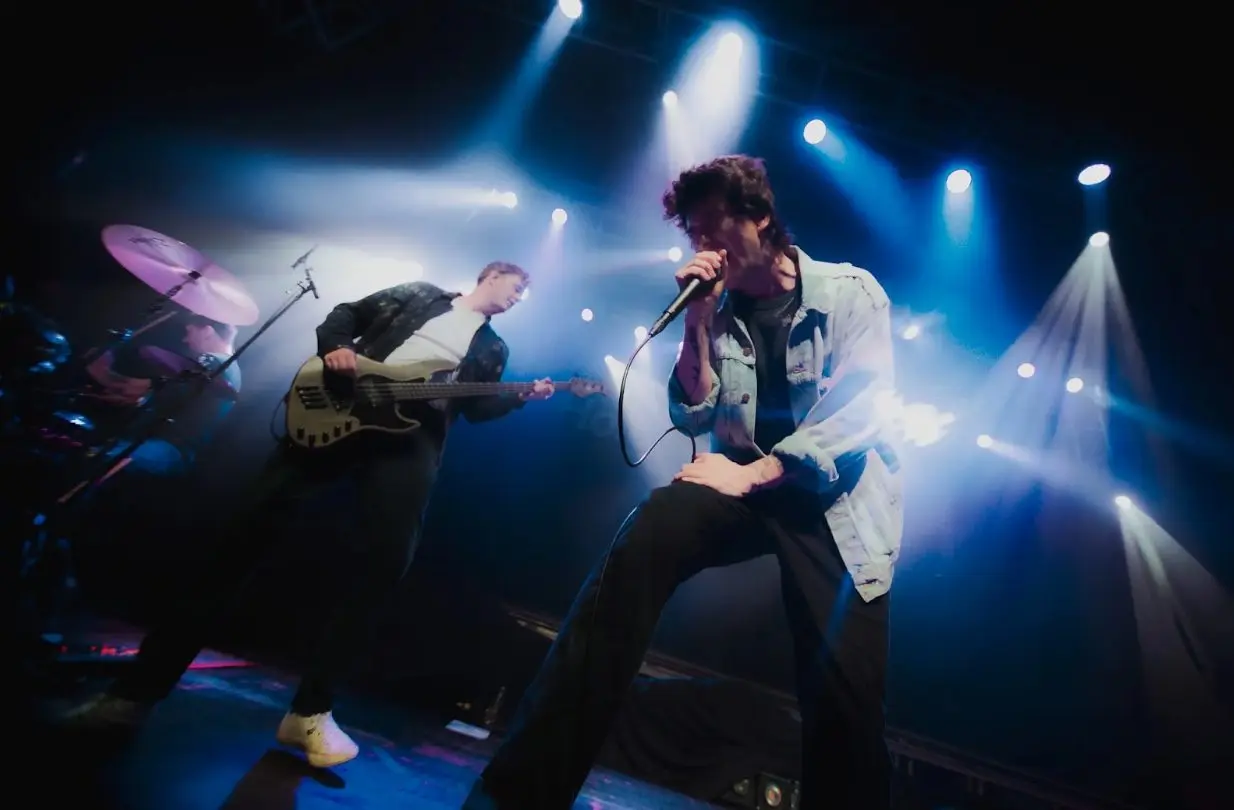
Holding Absence, a post-hardcore band from Cardiff, Wales, are not new to the music scene. Forming in 2015, with Lucas Woodland as their vocalist, Scott Carey on guitar, and Benjamin Elliot on bass, they have released three studio albums and gained a total of 827k monthly listeners on Spotify. They are well known for their hit song “Afterlife” off their sophomore album The Greatest Mistake of My Life, along with other notable tracks on that record, such as “Drugs and Love,” “Curse Me With Your Kiss,” and my personal favorite, “Nomoreroses.”
Having spent so many years writing, recording, and performing to get to where they are now, it was understandable that they were frustrated. Last month, Woodland took to X to publicly call out Bleeding Verse and give his thoughts on the situation, saying, “So, an AI ‘band’ who cite us as an influence (i.e., it’s modeled off our music) have just overtaken us on Spotify in only TWO months. It’s shocking, disheartening, it’s insulting — most importantly — it’s a wake-up call.”
As I’m writing this, on October 29th, Bleeding Verse has a whopping 637k monthly listeners. Their most popular song, “If You Loved Me Then,” has received over 3.5 million streams on Spotify and 156k views on YouTube. The band’s YouTube biography provides some information on its musical influences: “Inspired by artists like Dayseeker and Holding Absence, we blend ambient textures, soaring vocals, and poetic lyricism to explore grief, identity, and healing. Lyrics from the heart. AI-assisted instrumentation and vocals.” In other words, they put those bands’ names into a prompt for the artificial intelligence to learn from.
Following their first single that came out on July 28th, Bleeding Verse has put out an additional 21 songs. “[They’re] releasing songs at a pace physically impossible to replicate,” Woodland continued. “Chess robots have been beating world human champions for 30 years now.”
But Bleeding Verse isn’t the first AI band to blow up. The Velvet Sundown started in June of 2025, and they’ve been making releases at an astounding rate — including three full-length albums. Their biggest song, “Dust on the Wind,” currently has 3.4 million streams, and their Spotify monthly listener count is 241k. Additionally, DIESEL, another AI band, has gained 315k monthly listeners and 1.1 million streams and 278k YouTube views on its song “How Dare They.”
So, how are these bands receiving millions of streams and new followers despite being created by artificial intelligence? I believe that it’s because the AI targets emotions in their songs, trying to replicate something that draws most people to the music they listen to. Take Bleeding Verse’s biography on Spotify, for example: “Little is known about the faces behind Bleeding Verse, and that’s by design. The focus is the feeling: grief in reverb, hope in distortion, truth between the lines. For the broken, the seekers, the ones who don’t know how to say it out loud — this is for you.” The band’s biography is rather odd given the fact that the music was created using AI. It’s trying to relate to real, human emotions — despite being unable to feel them. I believe that music loses its meaning when that aspect is taken from it — it feels soulless, ingenuine, uncreative, and disconnecting. It isn’t art, connection, community, or anything that makes music special — it’s a product.
Music’s overlap with culture is another thing that cannot be replicated using AI. “Music has always been a part of human nature,” said Phillip Agonoy, a first-year Journalism major here at Seattle University. “We’ve been creating music for thousands and thousands of years. . .it’s become so intertwined with Native American culture, Filipino culture, [and] most Asian cultures. It’s important to a lot of cultures, and having it. . .creates such a deep meaning and connection with people.”
While I don’t believe that AI can ever replace real, authentic music, I do think that we could be looking toward an era where AI becomes much more prevalent – especially as it gets more advanced and better at mimicking humans. According to Billboard, there have already been six AI musicians that have reached their charts in the last couple of months.
Given that Spotify – the largest music streaming app in the world – has stated that it will continue to support “artists’ freedom to use AI creatively,” Woodland also provided some insight on what music lovers can do to help. “I believe we can only lobby for transparency now. Those artists should have “AI” on their Spotify artwork, so that [the algorithm] can’t sneak them onto playlists. Otherwise, violently support real music. Buy merch. Attend shows. That’s the most we can do for now.”
Taryn Walters | Music Reporter