
Author: Ariyana Kaur Dhaliwal
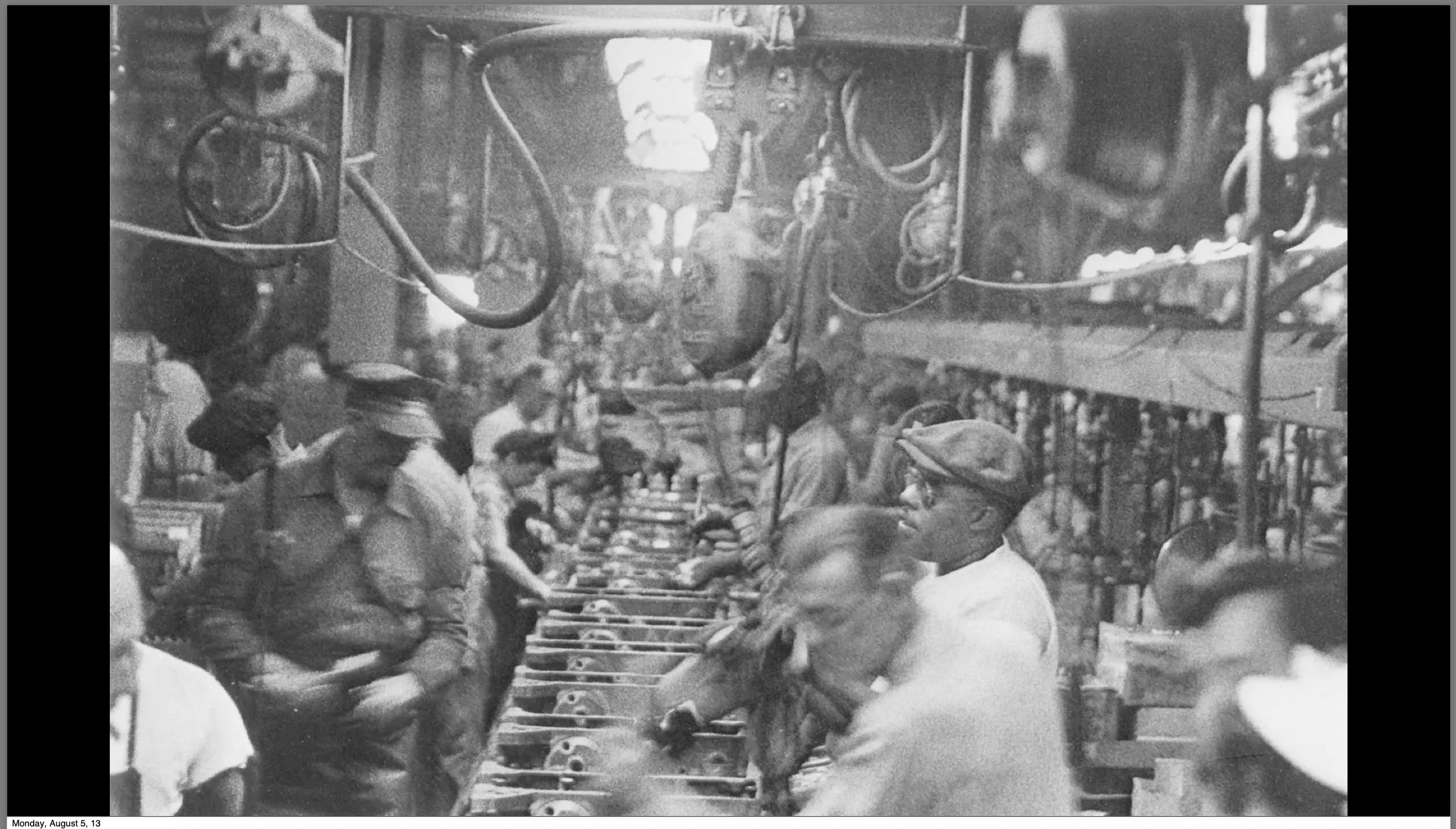
Cover photo: Robert Franks “The Americans” this specific photograph doesn’t have a title.
What does it mean to be an American? Guari Gill shows her thought through picturing the South Asian diaspora. Describing the lives behind immigrants. She shows this through her interpretation of Robert Frank’s The Americans (1959) (seen in cover photo). A piece about socioeconomic status, race and class and how it was unequal, to those who didn’t have the right combination of the three. Gauri is known for frequently using other pieces of work for inspiration, and using it to create her own collections. The collection captures the quiet complexities of immigrant life, revealing how the South Asian diaspora redefines what it means to be “American.”
The photograph “Indian grocery store in Queens, New York 2004” in “The Americans” series, depicts a deep understanding of the intricacies behind South Asian immigrant communities, at once humanizing its subjects while challenging the viewer’s internalized stereotypes, broadening the framework of what it means to be “American.”
This collection is an integral photographic work on American identity, by Robert Frank he is a renowned photographer who originally created a collection called “The Americans” he based the theme of his collection on the endangerment of minority groups in the 1950s. During the era in which he curated his collection, he was documenting the Civil Rights movement. During this time many different groups were being affected, and Frank’s The Americans touched on segregation, racism, and sexism. It was a captivating and integral piece that represented the lives of many on the margins.
Frank photographed many funerals, and protests, homes and gatherings very similar to the pieces that Gauri included, one that had a similar depiction or meaning to the photograph that is being examined, was a group of Black Americans, working in a factory, the photo blurry from the speed of the workers. Men running around and trying to get their assignment done as fast as possible. This is what the grocery store also depicted in a more somber and calm way, a less intense form of labor. But still both depicting the working day of marginalized groups.
Guari took inspiration from Frank’s interpretation of america and made a spin on “The Americans” showing less about hatred among Americans, but the hatred and isolation of the immigrants’ experience, specifically south asian immigrants. Guari curates the collection showing the memories, the happy moments and the sadness, anger and grief that any community experiences, but through a critical lens, commenting on how America treats its immigrants.
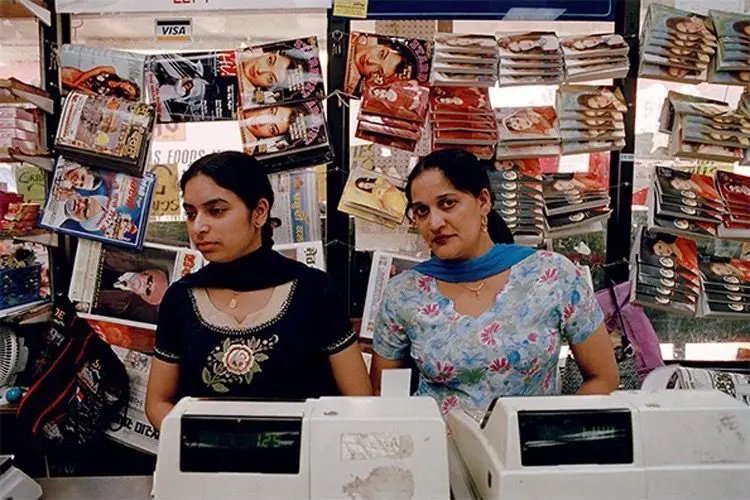
From Gauri Gill’s, “The Americans”, named “Indian grocery store in Queens, New York 2004.”
One representative piece in her collection is the photograph “Indian grocery store in Queens, New York 2004.” The photograph (Pictured above) is a reflection of so many Punjabi women around the world; the picture is colorful and bright. The two subjects wear pink, blue, and black traditional Punjabi clothing and gold earrings and necklaces that are simple and understated. Though people might think that wearing gold is a symbol of wealth and prosperity, it is a way for Indian parents to ensure that their daughter always has a safety net (Theculturegully 2024).
In this photo, it looks like there are multiple generations represented, presumably a woman and her mother running their grocery store in Queens, New York. Only her and her daughter are pictured, showing women working. Usually in the 2000s women weren’t as represented in the workforce, but living as immigrants trying to create success for themselves and their families everybody needed to contribute (Theculturegully 2024).
The mother is expressionless, making eye contact with the camera and her daughter looks far away and to the ground. Both look somber and overworked, the pictures overall feeling very stagnant. This may be a reflection of women taking on the biggest burden in the family structure: having to keep the family together, perform the household duties, and work full time.
The backdrop of the picture firmly situates the women within a shared Indian cultural identity. There are lines and lines of magazines and Punjabi newspapers, all riddled with different colors and famous South Asian actors and politicians on the front. They are strung up behind the old, tattered cash registers. All of the papers and magazines blend together in one synchronization. This is similar to the way the women are moving in a sort of synchronization towards something out of the frame.
Nothing looked manipulated in the photograph; to seem a certain way or portray a certain idea or theme. It has a desire to show the everyday and the ordinary. It’s candid and real, Gauri wanted to represent the truth. It shows struggle and hard work, and it shows that nothing is easy. There is a weight in the mother’s eye, dark from sleepless nights and worry, strained from the mundane needs of life. The photograph’s subjects and setting match the way that many South Asians felt working through their schedules everyday just to succeed.
Gauri’s method when it comes to taking a photo “is a deeply immersive and collaborative approach to image-making”(Anand 2025). She created the foundations of her collection by connecting with marginalized people of the diasporic Indian communities through long-term interactions and relationships. She is able to capture the hardworking, resilient and beautiful communities at an intimate level, highlighting those who are overlooked and unrepresented.
Active listing is one of Gauri’s greatest strengths when it comes to the process of taking her photographs as she explains in an interview, “my job as I see it is to be sensitive, curious andopen to what is already there. It is more about trying to get out of the way in order to listen acutely to what is subtle or unsaid—or unsayable—and usually at the margins outside dominant discourses of power” (Anand 2025). Gauri fought to speak for the unspoken.
The photo is natural and candid but Gauri did have a part in the process, “ I do intervene in the artistic choices I made at every stage, and that is the active part, but the attempt is to try and do that in as light and transparent and playful a manner as possible” (Anand 2025). Gauri describes that she does change and manipulate the stage to be a certain way but never changing the depiction or the truth behind the image.
It is a very intimate setting, and communities are being vulnerable, showing the deep complexities of their lives, especially when there is so much hate towards them as marginalized communities. They are invisible in the lives of others, but in this collection immigrants are seen as strong and powerful. That is the key to Gauri’s work: to show the unknown and bring awareness to marginalized communities.
“The Americans” is a cultural reflection of the time and effort that South Asians have put into the communities and areas around them so that their people can feel more at home, cultivating communities where they feel welcome and are able to be their true selves. The series highlights the importance of sharing culture, faith and traditions. This is portrayed in “The Americans” as a sort of family album, bringing the subjects and the audience closer.
The collection takes place over seven years pre and post the 9/11 era, a significant event not only for Americans and the world, but especially for the South Asian and brown communities in the U.S.A (Patel 2024). This photo is post 9/11, and the stress and uncertainty of this time is shown in the picture, seeing the strain it has put on this family, adds to the somber and eerie feeling depicted in the photo.
During this time the South Asian diaspora was heavily affected and it disrupted their lives as they were now seen as a target and something that needed to be controlled. This caused the increased hate crimes and violence towards South Asians. The U.S Department of Justice proclaimed that there had been over “800 incidents since 9/11” in 2015, “involving violence, threats, vandalism and arson against Arab-Americans, Muslims, Sikhs, South-AsianAmericans… The incidents had consisted of minor assaults as well as assaults with dangerous weapons and assaults resulting in serious injury and death; and vandalism, shootings, arson and bombings directed at homes, businesses, and places of worship.”(Combating post-9/11 discriminatory backlash 2015). Causing the South Asian population to stop sharing as much about their culture and to retreat to preservation of their communities.
When Gauri touches on the intense hate crimes of this era towards South Asians, within her collection it is like capturing the moment in time. So that people in hundreds of years won’t have to learn from their mistakes but to see the ones made before them and learn for the first time. It is a way for them to be able to look back and see what happened and not repeat it.
Guari captures the moments in these people’s lives as if they are capsules of time. Gauri has a special way of getting her photos to have a certain sense of home and safety, she developed long term relationships with her subjects to make sure that they’d felt more comfortable, giving the photographs a certain calming factor.
The photograph represents how Indian immigrants had preserved their culture, capturing their clothes, jewelry, literature like the magazines in the background, music and cinema. As depicted in the photograph, many immigrants made their livelihood on Indian goods and culture, creating a tether to their home countries and fellow immigrants. Even through persecution andprejudices, they had passed down their culture to their future generations. Photography like this preserves their identity and resilience like a time capsule in their family history.
Gauri created these pieces of art to represent a community that was suffering in silence,and the echoes of her work still roar through the community because “The Americans” is still relevant today. With increasing hate crimes towards South Asians rising every year since the recent election, people need to be reminded of the effort and dedication South Asian immigrants had put into the U.S. In February of 2024, a young immigrant woman was killed by a police officer in Seattle (Patel 2024), and the crimes went unnoticed, the police man who brutally ran over her was convicted of no crime and sentenced to no time in jail. These are the occurrences that Gauri is trying to portray in her work, showing the outside world a different side to South Asians, countering the propagandized narrative. Giving South Asians the opportunity to change the way they are perceived in the world humanizes and diversifies ideas about South Asians.
The India Currents article details the various other hate crimes happening to south asian immigrants around the U.S, leading into a reflection about Gauri Gills, collection, “The Americans.” These stories inspired the curator of Columbia University’s Wallach Art Gallery in New York, to display Gauri’s art. (Patel 2024)
When talking about how she came to this conclusion, she stated, “these hate crimes are heartbreaking yet common headlines in America today. As our community mourns these individuals, we grapple with how such stories are tied to our immigrant histories and reflect our own ongoing questioning, examining, and reassessment of our existence as Americans” (Patel 2024). By giving people the opportunity to experience south asian culture and see the lives behind immigrants, it makes it easier for people to choose kindness and think about immigration in a different way.
Gauri Gill came out with the collection over 20 years ago but what she was striving for then people are still looking for in modern America because only a small window of change has occurred. The conversation about immigrants has not gotten better, but it has gotten more diverse in opinions and ideas. Despite this, the same complaints and stereotypes about immigrants are still perpetuated.
The current state of the U.S is a clear description of the type of discord that Gill did not want for South Asians, and immigrants in general. The current administration has clearly no intention of representing immigrants in a positive light. The conversations and threats that the leader of the U.S.A, has proclaimed against real Americans is utterly unconstitutional and something this collection is completely against. The need for representation is an everlasting battle but propping up art like this gives the opportunity for South Asians to speak for their people and gives marginalized communities the ability to represent themselves.
Gauri’s work goes beyond the concept of immigrants having to balance two identities and worlds, but the idea that being an immigrant is an extreme type of duality. It is the power of creating a world with a mix of concepts from the past and the present. This collection was created from 2000 to 2007 and appeared all over the world and all over the U.S., showing the complex nature of immigration and specifically South Asian immigrants.
“The Americans” gives insight into immigrant lives that is an untold and unseen story. Touching on so many different realities and experiences, and opportunities for these individual groups within the South Asian diaspora across the U.S. The meaning being the photograph is to give total and unfiltered representation of immigrant lives. And brought awareness to the prejudice against these communities. In a way it can cause art to unite communities and cultures, striving for a better America for everyone in it including immigrants.
Ariyana Kaur Dhaliwal | Guest Writer